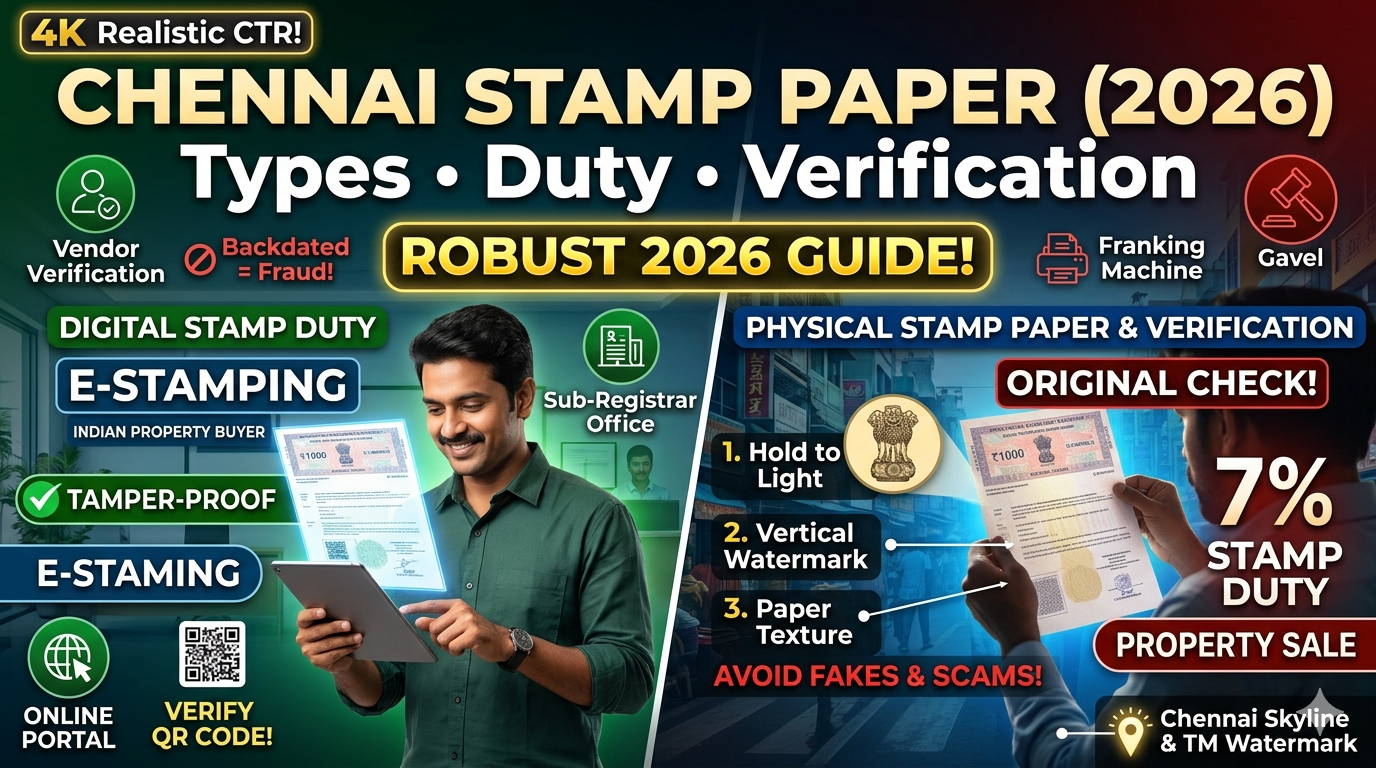
Stamp Paper in Chennai Guide 2026: Types, Stamp Duty & Original Check
Stamp paper in Chennai plays an important role in legal, financial, property, and business documentation. Whether you are buying property, creating a rental agreement, signing a business contract, or submitting an affidavit, understanding how stamp paper works in Tamil Nadu is essential.
One of the most commonly used categories is the non-judicial stamp paper, which is widely accepted for legal agreements, registrations, and commercial transactions.
In this 2026 updated guide, you’ll learn:
- Types of stamp papers available in Chennai
- Latest stamp paper denominations
- Common stamp duty charges
- Difference between judicial and non-judicial stamp papers
- How to identify original vs fake stamp paper
- Whether backdated stamp paper is legal
- Important 2026 updates regarding e-stamping and franking
What is Stamp Paper?
Stamp paper is an official government-issued paper used for preparing legal and financial documents. It acts as proof that the required stamp duty (government tax) has been paid on the transaction or agreement.
Documents executed on valid stamp paper become legally enforceable and acceptable in the following:
- Courts
- Banks
- Government departments
- Registration offices
- Financial institutions
Stamp paper helps establish authenticity, reduce disputes, and provide legal evidence between parties.
Why Do You Need Stamp Paper?
Using proper stamp paper offers several legal and practical benefits:
- Proves that the required stamp duty has been paid
- Makes agreements and contracts legally binding
- Helps prevent fraud and disputes
- Ensures documents are admissible as evidence in courts
- Required for registrations, property transfers, and financial agreements
Without proper stamping, certain documents may become legally weak, attract penalties, or face rejection during registration.
Types of Stamp Paper in Chennai (2026)
Stamp paper in Chennai is broadly divided into four categories.
1. Judicial Stamp Paper
Judicial stamp papers are used only for court-related matters, such as:
- Court fees
- Legal proceedings
- Petitions
- Litigation filings
These cannot normally be used for regular commercial or property documentation.
2. Non-Judicial Stamp Paper
Non-judicial stamp paper is the most commonly used type in Chennai.
It is used for:
- Property registration
- Sale agreements
- Rental agreements
- Affidavits
- Indemnity bonds
- Partnership deeds
- Power of attorney
- Loan agreements
- Import/export documentation
- Business contracts
Compared to judicial stamp papers, non-judicial papers are far more versatile and widely used.
3. E-Stamp Paper (Electronic Stamp)
E-stamping is the modern digital method of paying stamp duty.
Benefits of e-stamp paper include:
- Tamper-proof system
- Easy online verification
- Faster processing
- Reduced fraud risk
- Accepted for registrations and legal transactions
For high-value transactions such as property purchases, e-stamping is now strongly preferred in Chennai.
4. Franking (Machine-Stamped Documents)
Franking is a process where stamp duty is printed directly onto the document using a franking machine.
Traditionally used by banks and financial institutions, franking is now increasingly integrated into many Sub-Registrar Offices (SROs) in Chennai.
2026 Update: Franking at Chennai SROs
Many Chennai sub-registrar offices now offer on-site franking facilities. After paying the registration fee through an authorized challan or payment system, the SRO can frank the document directly.
This method is considered safer than relying entirely on pre-purchased physical stamp paper for certain transactions.
Difference Between Stamp Papers and Stamps
Many people confuse stamp papers with adhesive stamps, but they serve different purposes.
Revenue Stamp
Revenue stamps are used when an organization makes a cash payment of ₹5,000 or more to an individual as proof of receipt.
Notarial Stamp
A notarial stamp is used by a notary public to authenticate or certify documents.
Postage Stamp
Postage stamps are adhesive stamps used for mailing letters and parcels through postal services.
Stamp Paper Denominations Available in Chennai (2026 Update)
As of 2026, the following physical stamp paper denominations are commonly available in Tamil Nadu:
- ₹100
- ₹500
- ₹1,000
- ₹5,000
The Tamil Nadu government has discontinued several lower and higher denominations, including:
Discontinued Lower Denominations
- ₹10
- ₹20
- ₹50
Discontinued Higher Denominations
- ₹10,000
- ₹15,000
- ₹20,000
- ₹25,000
This move was introduced to reduce the cost and logistics of printing and transporting physical stamp papers.
For discontinued values, authorities now encourage:
- E-stamping
- Franking systems
Documents Required for Buying Stamp Paper in Chennai
For general-purpose stamp paper purchases, requirements are usually minimal.
Typically, you only need:
- Name of the person for whom the paper is being issued
For property registration or legal registration purposes, additional identity proof may be required, such as:
- Aadhaar Card
- Driving License
- PAN Card
- Passport
- Other government-issued ID proof
Important Aadhaar Privacy Note (2026)
While Aadhaar may be used for verification during property or registration-related transactions, Aadhaar numbers should always remain confidential.
Authorities should verify either
- The physical Aadhaar card, or
- The secure Aadhaar QR code
Avoid publicly sharing or printing Aadhaar numbers unnecessarily on agreements or public-facing documents.
Common Stamp Duty Rates in Chennai (General Overview)
Actual charges may vary depending on document type, property category, guideline value, and transaction nature.
1. Property Sale / Transfer
Typical Charges
- Stamp Duty: Around 7%
- Registration Fee: Around 1%
The calculation is generally based on:
- Market value, or
- Government guideline value
whichever is higher.
2026 Guideline Value Alert
Before property registration, ensure the latest Chennai guideline value for the exact street or survey number is checked. Incorrect valuation can lead to penalties or registration delays.
2. Rental / Lease Agreements
Rental agreements generally attract fixed or percentage-based stamp duty depending on the following:
- Monthly rent
- Security deposit
- Lease duration
Many agreements are commonly executed on:
- ₹100 or ₹200 Non-Judicial Stamp Paper
3. Affidavits / Declarations
Affidavits are usually executed on:
- ₹100 Non-Judicial Stamp Paper
4. Power of Attorney (POA)
POA charges vary depending on whether it is:
- General POA
- Special POA
- Property-related POA
Stamp duty may range from ₹100 to higher values based on the transaction.
5. Business Agreements / Contracts
Commercial agreements are commonly executed on:
- ₹100
- ₹200
- Higher-value non-judicial stamp papers depending on contract value
How to Identify Original vs Fake Stamp Paper
Fake stamp papers continue to be a concern in high-value transactions. Here are the most reliable ways to verify authenticity.
1. Check the Security Watermark
Hold the paper against light.
Original stamp papers usually contain the following:
- Vertical security watermark
- Transparent Ashoka Emblem
Fake papers may show:
- Repetitive printed marks
- Blurry watermarks
- Poor-quality imitation designs
2. Verify the Paper Quality
Genuine stamp paper is printed on special security-grade paper.
The original paper usually feels
- Slightly thicker
- Firm
- Sharp in texture
Fake paper may feel
- Thin
- Rough
- Low-quality
- Easily tearable
3. Check the Texture and Thickness
Authentic stamp papers have a distinct texture and thickness.
Counterfeit papers often resemble normal printer paper and may feel
- Too smooth
- Too soft
- Flimsy
If the paper quality feels suspiciously weak, verify before use.
4. Verify Stamp Vendor Details
Every genuine stamp paper in Tamil Nadu should contain:
- Licensed Stamp Vendor Name
- Vendor License Number
- Unique Serial Number
- Date of Issue
If these details are
- Missing
- Overwritten
- Unclear
- Poorly printed
the document may be fake or invalid.
Buying Backdated Stamp Paper in Tamil Nadu – Is It Legal?
No. Buying or using backdated stamp paper is illegal in Tamil Nadu.
According to registration regulations, stamp papers must be
- Issued only by licensed vendors
- Sold at face value
- Printed with a valid issue date
- Traceable using official serial numbers
Using fraudulent or backdated stamp paper may amount to:
- Forgery
- Fraud
- Cheating
- Violation of the Indian Stamp Act
Such activities are punishable under Indian law.
2026 Action Checklist for Safe Stamp Paper Usage
Prioritize E-Stamping
For high-value transactions like property purchases, e-stamping is the safest and most easily verifiable option.
Buy Only From Licensed Vendors
Always verify:
- Vendor license number
- Serial number
- Date of issue
before purchasing physical stamp paper.
Verify Guideline Value Before Registration
Ensure stamp duty is calculated using the latest 2026 guideline value applicable to the specific Chennai property location.
Use Secure Aadhaar Verification
Never publicly disclose Aadhaar digits during document preparation or registration.
Use secure QR-based or physical verification methods whenever possible.
Physical Stamp Paper Availability in Chennai
Physical non-judicial stamp papers such as
- ₹100
- ₹500
- ₹1,000
- ₹5,000
may be available at licensed vendors including:
Durgammal Associates
No.336, MKN Road, Alandur, Chennai – 600016
Adjacent to Alandur Court, next to Kurinji Exports.
Always verify vendor authorization before purchase.
Frequently Asked Questions (FAQs)
1. Where can I buy stamp paper in Chennai?
You can buy it from:
- Licensed stamp vendors
- Sub-Registrar Offices (SROs)
- Authorized e-stamping providers
2. Is e-stamp paper valid in Tamil Nadu?
Yes. E-stamp paper is fully valid, secure, and widely accepted for legal and registration purposes.
3. Can I buy stamp paper online?
Yes. E-stamp certificates can be obtained through authorized service providers.
No. Backdated stamp paper is illegal and considered fraudulent.
5. Does stamp paper expire?
Stamp paper generally does not expire, but it must still comply with applicable legal and registration rules at the time of use.