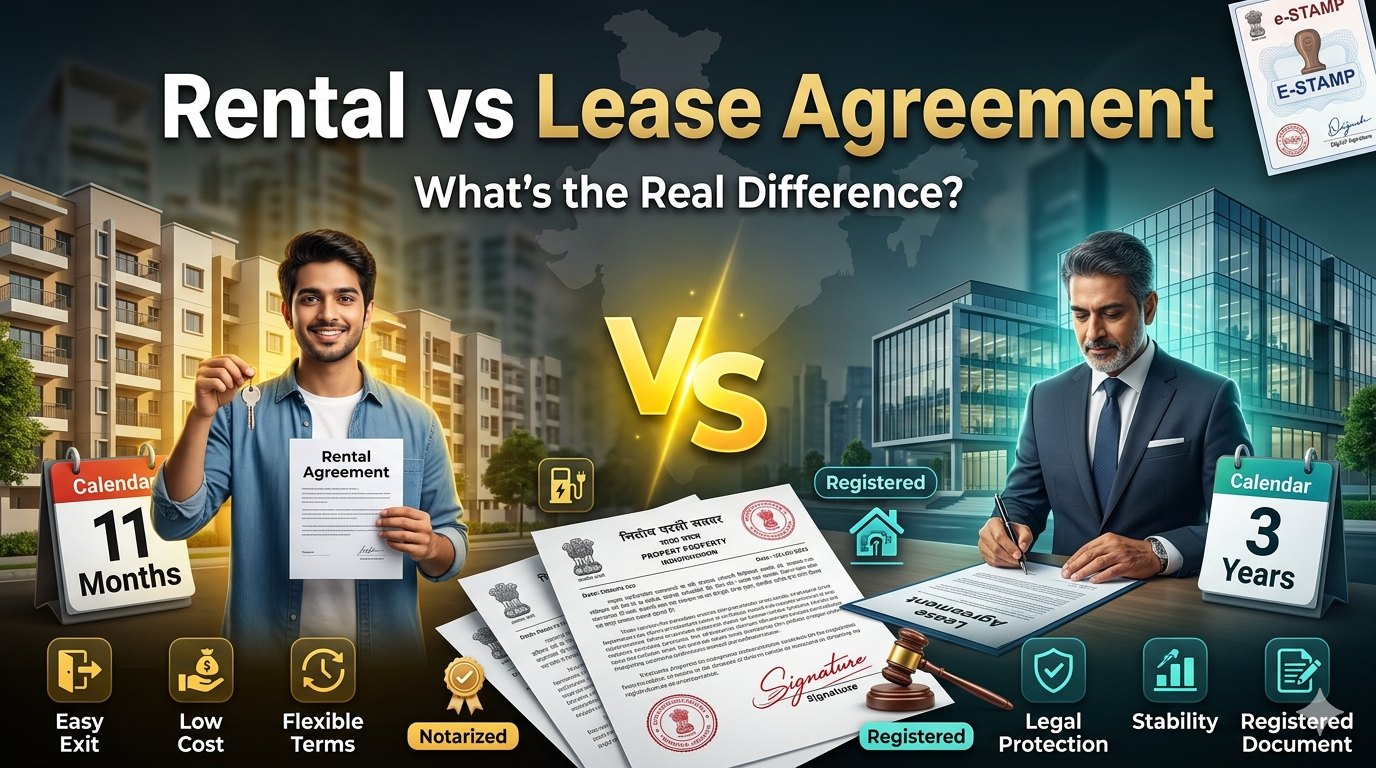
Key Differences, Legal Validity, Registration Rules & Safety Tips
Renting or leasing property is extremely common across India, especially in fast-growing cities like Chennai, Bengaluru, and Hyderabad.
However, many people still use the terms “rental agreement” and “lease agreement” interchangeably—without realizing that they are legally different documents with different rights, obligations, and legal protections.
This confusion often leads to:
- Deposit disputes
- Legal complications
- Registration problems
- Commercial tenancy conflicts
- Financial losses
If you are a tenant, landlord, business owner, or property investor, understanding the difference between a rental agreement and a lease agreement is essential in 2026.
This practical guide explains everything in simple language, including:
- Legal differences
- Registration rules
- Stamp duty
- Tenant and landlord rights
- Commercial vs residential usage
- EV charging and smart home clauses
- E-stamping and digital execution trends
What Is a Rental Agreement?
A rental agreement is a short-term contract between a landlord and a tenant, usually valid for up to 11 months.
In legal terms, a rental agreement mainly provides the tenant with a license to occupy the property temporarily, while the landlord continues to retain greater control over the premises.
Rental agreements are designed for flexibility and are commonly used for residential properties.
Key Features of a Rental Agreement
- Short-term arrangement
- Usually valid up to 11 months
- Easier renewal process
- Flexible for both parties
- Lower stamp duty
- Easier rent revision
- Suitable for temporary occupancy
- Commonly used for residential properties
When Is a Rental Agreement Used?
Rental agreements are commonly preferred for:
- Apartments and flats
- Independent houses
- PG accommodations
- Temporary work relocation
- Students and working professionals
- Families needing flexible occupancy
Landlords also prefer rental agreements when they want the flexibility to revise rent periodically or change tenants easily.
What Is a Lease Agreement?
A lease agreement is a long-term legal contract where the owner transfers the right to use the property for a fixed duration.
Lease periods can range from
- 1 year
- 3 years
- 10 years
- Up to 99 years in some cases
Unlike a rental agreement, a lease generally creates a stronger legal interest in the property for the lessee during the lease term.
This distinction becomes especially important in commercial real estate.
- Long-term arrangement
- Fixed terms and conditions
- Stronger legal protection
- Higher stamp duty
- Compulsory registration if exceeding 12 months
- Stable occupancy rights
- Limited flexibility during lease term
- Common in commercial and industrial properties
When Is a Lease Agreement Used?
Lease agreements are commonly used for:
- Office spaces
- Retail shops
- Commercial complexes
- Factories and warehouses
- Industrial land
- Corporate housing
- Long-term residential occupancy
Commercial property owners usually prefer lease agreements because they provide predictable long-term income and tenant stability.
Rental Agreement vs Lease Agreement—The Real Difference
Most people think the difference is only about duration.
But legally, the real distinction is deeper.
A rental agreement mainly grants temporary permission to occupy the property.
A lease agreement grants a stronger legal right and interest in the property for the agreed duration.
- Commercial disputes
- Eviction matters
- Long-term occupancy claims
- Court enforceability
- Property possession rights
Rental Agreement vs Lease Agreement – Comparison Table
| Feature | Rental Agreement | Lease Agreement |
|---|---|---|
| Duration | Usually up to 11 months | Usually 1–99 years |
| Nature | Temporary occupancy/license | Legal interest in property |
| Flexibility | High | Limited |
| Registration | Usually not compulsory below 12 months | Mandatory above 12 months |
| Stamp Duty | Lower | Higher |
| Rent Revision | Easier | Usually fixed |
| Legal Protection | Moderate | Stronger |
| Best For | Residential use | Commercial & long-term use |
Which Agreement Is Better for Tenants?
For most residential tenants, a rental agreement is more practical because it offers:
- Easier exit
- Lower legal costs
- Flexible renewal
- Less long-term commitment
- Easier relocation
However, tenants looking for long-term stability may benefit from a lease agreement because it offers stronger protection against:
- Sudden eviction
- Frequent rent hikes
- Arbitrary changes in terms
Which Agreement Is Better for Landlords?
The right choice depends on the landlord’s objectives.
- You want flexibility
- You prefer short-term tenants
- You want frequent rent revisions
- You may sell the property soon
A lease agreement is better if:
- You want stable long-term income
- You are renting commercial property
- You want lower vacancy risk
- You prefer long-term occupancy security
Legal Validity in India
Rental Agreement
A rental agreement below 12 months generally does not require compulsory registration.
Because of this, many short-term agreements are notarized instead.
However, there is an important legal clarification many people misunderstand.
Many people believe notarization alone makes a rental agreement fully legally secure.
This is incorrect.
A notarized agreement mainly serves as
- Proof of transaction
- Proof of possession
- Supporting evidence
But notarization is NOT a substitute for registration.
If a serious dispute arises, an unregistered agreement may face limitations in court, especially regarding the enforceability of disputed contractual terms.
Lease Agreement Legal Rules
Lease agreements exceeding 12 months must generally be registered under Indian law.
Lease agreements are primarily governed by:
- The Transfer of Property Act, 1882
- State registration laws
- Applicable rent control regulations
An unregistered lease may become difficult to enforce legally.
Registration provides:
- Stronger evidentiary value
- Better legal protection
- Greater clarity during disputes
Stamp Duty Difference
Stamp duty varies by state.
Rental Agreement
Generally ranges between:
- 0.25% to 1% of annual rent
Lease Agreement
Usually calculated based on:
- Lease duration
- Lease value
- Security deposit
- Premium amount
Depending on the state, lease stamp duty may range from
- 1% to 7%
⚠️ Always verify the latest rates applicable in your state.
Important Clauses to Include in 2026
Modern agreements now require far more than basic rent and deposit terms.
Several new clauses have become essential in urban India.
EV Charging & Infrastructure Clause
With rising EV adoption in India, EV-related disputes are becoming increasingly common in apartment complexes and commercial buildings.
A modern agreement should clearly define the following:
- Who pays for EV charger installation
- Electricity billing responsibility
- Dedicated parking allocation
- Common charging access rights
- Maintenance of charging equipment
In cities like Hyderabad and Bengaluru, this has already become a major concern for premium tenants.
Digital Infrastructure Clause
High-speed internet and smart home systems are now standard expectations in urban properties.
Modern agreements should clearly define responsibility for:
- Fiber optic installation
- Internet routing permissions
- Smart lock maintenance
- CCTV systems
- Digital access controls
- Wi-Fi infrastructure maintenance
This is especially important in modern apartments and commercial office spaces.
Force Majeure 2.0 Clause
After 2020, force majeure clauses became significantly more important.
Modern agreements should include protections related to the following:
- Pandemic lockdowns
- Government restrictions
- Structural access limitations
- Natural disasters
- Emergency building closures
- Delayed occupancy due to public emergencies
These clauses protect both landlords and tenants from unforeseen disruptions.
Commercial Leasing Trends in 2026
Commercial leasing in India is evolving rapidly.
Traditional rigid lease structures are slowly changing.
Rise of Commercial Licensing Models
Many startups and businesses now prefer flexible commercial licensing arrangements instead of long-term traditional leases.
Modern commercial occupancy models now include the following:
- Managed office spaces
- Co-working licenses
- Flexible lock-in periods
- Revenue-sharing occupancy models
- Hybrid commercial agreements
This trend is growing rapidly in metro business districts.
E-Stamping & Digital Execution
Paperless property transactions are becoming standard in Tier-1 cities.
Modern agreements increasingly use the following:
- E-stamping platforms
- Aadhaar-based e-signatures
- Online document verification
- Digital contract execution
- Cloud-based document storage
Digital execution improves speed, transparency, and convenience for both landlords and tenants.
Common Clauses in Both Agreements
Regardless of agreement type, the following clauses should always be included:
- Landlord and tenant details
- Property description
- Rent amount and due date
- Security deposit
- Maintenance responsibilities
- Utility bill responsibilities
- Lock-in period
- Notice period
- Renewal terms
- Termination clause
- Parking rights
- Furnishing details
- Penalty clauses
Common Mistakes People Make
❌ Using a rental agreement for long-term commercial use
❌ Not registering a lease agreement
❌ Assuming notarization equals registration
❌ Missing exit clauses
❌ Ignoring EV charging rules
❌ Not defining maintenance responsibilities
❌ Failing to verify ownership documents
❌ Ignoring digital infrastructure obligations
FAQs – Rental Agreement vs Lease Agreement
1. Can a rental agreement exceed 11 months?
Yes. However, if the duration exceeds 12 months, registration usually becomes compulsory.
2. Is a lease agreement safer?
Yes. A properly registered lease agreement generally offers stronger legal protection.
3. Which agreement is cheaper?
Rental agreements are usually cheaper because they involve lower stamp duty and registration costs.
4. Can rent increase during a lease?
Usually no, unless the agreement specifically allows periodic escalation.
5. Is notarization enough?
For short-term arrangements below 12 months, notarization is commonly used.
However, notarization alone does not provide the same legal strength as registration.
6. Which agreement is best for commercial property?
Lease agreements are usually preferred because they provide stronger occupancy rights and long-term business stability.
Final Verdict
A rental agreement is best for:
- Short-term residential use
- Flexibility
- Temporary occupancy
- Lower legal costs
A lease agreement is best for:
- Long-term occupancy
- Commercial property
- Legal security
- Stable rental income
Choosing the right agreement can help avoid future legal disputes, financial losses, and occupancy conflicts.
Conclusion
Understanding the difference between a rental agreement and a lease agreement is essential for every tenant, landlord, and property investor in India.
Choose a rental agreement if flexibility and short-term occupancy are your priorities.
Choose a lease agreement if you want long-term stability and stronger legal protection.
Before signing any agreement, it is always advisable to consult a qualified property lawyer or legal drafting expert to ensure the document protects your interests properly.